
Two functions in the same place
A derailment provision consists of steel guide rails in the centre of the track. If a train derails, those rails catch the wheels and guide the vehicles along the track, so the train does not overturn and greater damage is avoided. The provision does nothing as long as all is well; it is precisely at the moment things go wrong that it has to be effective.
That same centre of the track is also home to the ERTMS balise, the beacon between the rails that exchanges information with passing trains. The two functions do not simply tolerate each other: in the immediate vicinity of a balise, no steel may be present. The steel guide rails are therefore interrupted over a short distance. The required metal-free opening is 650 mm.
The situation is also becoming more common. In the years ahead, more and more lines, with widely varying line speeds and track geometry, are to be fitted with ERTMS. Every balise in a track with a derailment provision means one of these interruptions.
Why those 650 mm matter
Over the length of the gap, a derailed wheel is unguided. A wheel with a small diameter in particular may then not be guided properly past the balise, so it is exactly here that a derailment can still escalate. The guidance is thus least effective at one of the places where it may be needed.
Interrupting the guidance also has a structural consequence. Where the guide rails end, free ends are created. These are weaker than a continuous guide rail, while the transverse forces of a derailed wheel can act on them undiminished. The interruption therefore weakens the structure at precisely the spot where the guidance is already interrupted.
Accept the gap, or reduce it
Anyone wanting to combine a balise with a derailment provision has, in essence, two options.
The first is to accept the interruption as it is. The guide rails end 650 mm apart and the gap remains unguided. Sometimes the ends of the guide rails are given a small chamfer. This is today’s practice: the balise works, and the residual risk of the unguided opening is accepted.
The second is to reduce the unguided opening with a material that does not disturb the balise. One thing is fixed: the metal-free opening is a requirement and remains 650 mm. Extending the guide rails in steel is therefore ruled out. Plastic falls outside that restriction. Plastic extenders on the ends of the guide rails continue the guidance closer to the balise, while the metal-free opening remains unchanged. The distinction is a precise one: the metal-free opening stays 650 mm, while the unguided opening shrinks from 650 to 330 mm. Even a derailed wheel with a small diameter then remains guided correctly past the balise.
Such a solution has to do more than guide. It must compensate for the weakening caused by the interruption, for instance by joining the free ends of the left and right guide rails with a connector. It must not interfere with the functioning of the balise, and it must keep the balise accessible for maintenance. And it must withstand the transverse forces a derailed wheel can exert, across the full range of line speeds and curve radii over which ERTMS is being rolled out in the years ahead. Finally, anything added to the track soon becomes one more object to maintain; a solution that needs no maintenance of its own keeps the asset management simple.
Where we come in
With Balise Protect, Kampa supplies a solution following the second approach. Plastic extenders lengthen the ends of the steel guide rails while the metal-free opening of 650 mm is maintained; the unguided opening comes down to 330 mm. A connector between the left and right guide rails compensates for the weakening caused by the interruption and stiffens the free ends.
Dekra Rail tested the system mechanically and established a load capacity of roughly three times the acting transverse force, regardless of line speed or curve radius. The extenders do not interfere with the functioning of the ERTMS balise and do not obstruct its maintenance. The system itself is maintenance-free and has been in service at various locations on the track for several years.
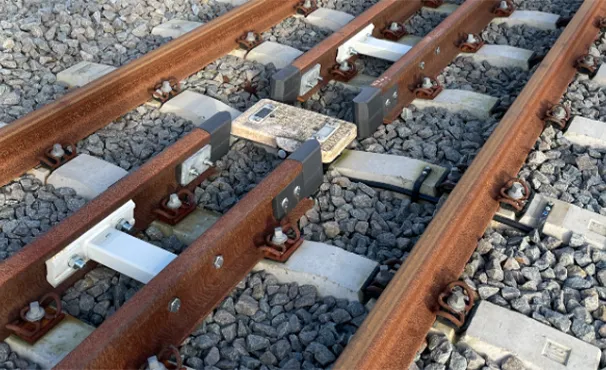
The interrupted guide rails around the balise, with the Kampa extenders narrowing the gap.