
DeltaSwitch
The bistable mechanism that improves the throw of the switch rail. Simple to install and adjust, and no grease in the ballast, ever.
Smooth movement of the switch rails is essential for safe, reliable switches and crossings. DeltaSwitch is a low-maintenance system for high or low switch rail profiles, suitable for all types of switches.
The rotating bistable pendulum block lifts the switch rail clear of the sliding chairs during the stroke. Friction disappears, lubrication becomes superfluous, and the rail settles firmly into either end position. Proven in service in the Netherlands, Belgium and Canada, among other countries.
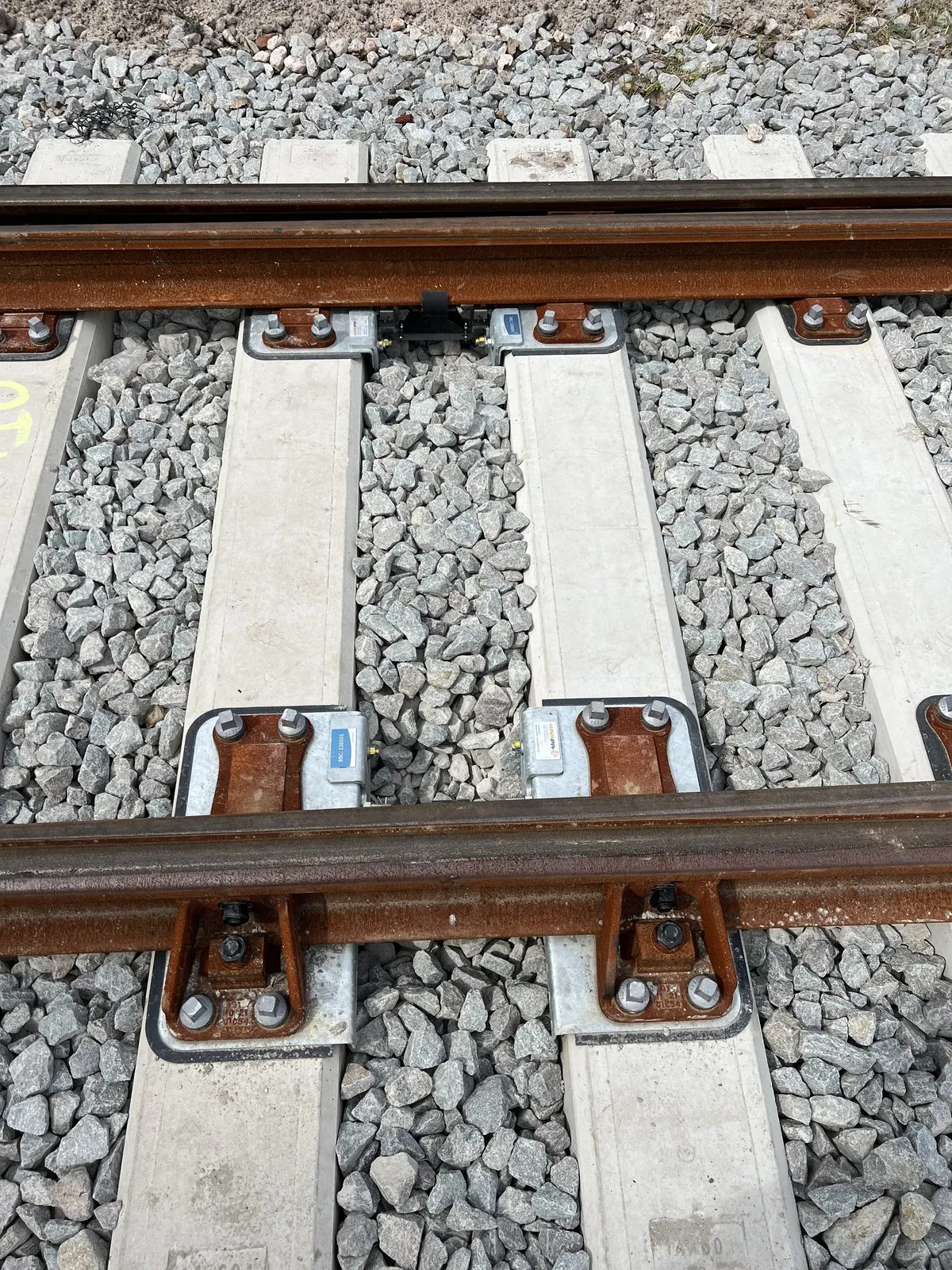
The problem it solves
Greased slide chairs are a recurring cost, not a solved problem.
Conventional switches need routine greasing of the slide chairs, and the rollers that partially lift the switch rail depend on adjustment and bearing condition that is not always adequate. Switch rails that are slightly deformed do not close properly against the stock rail.
The result: gauge narrowing, a risk of wheels striking the switch rail, possessions needed for greasing, lubricant ending up in the ballast, and high loads on point machines.
The bistable block engages on the stroke.
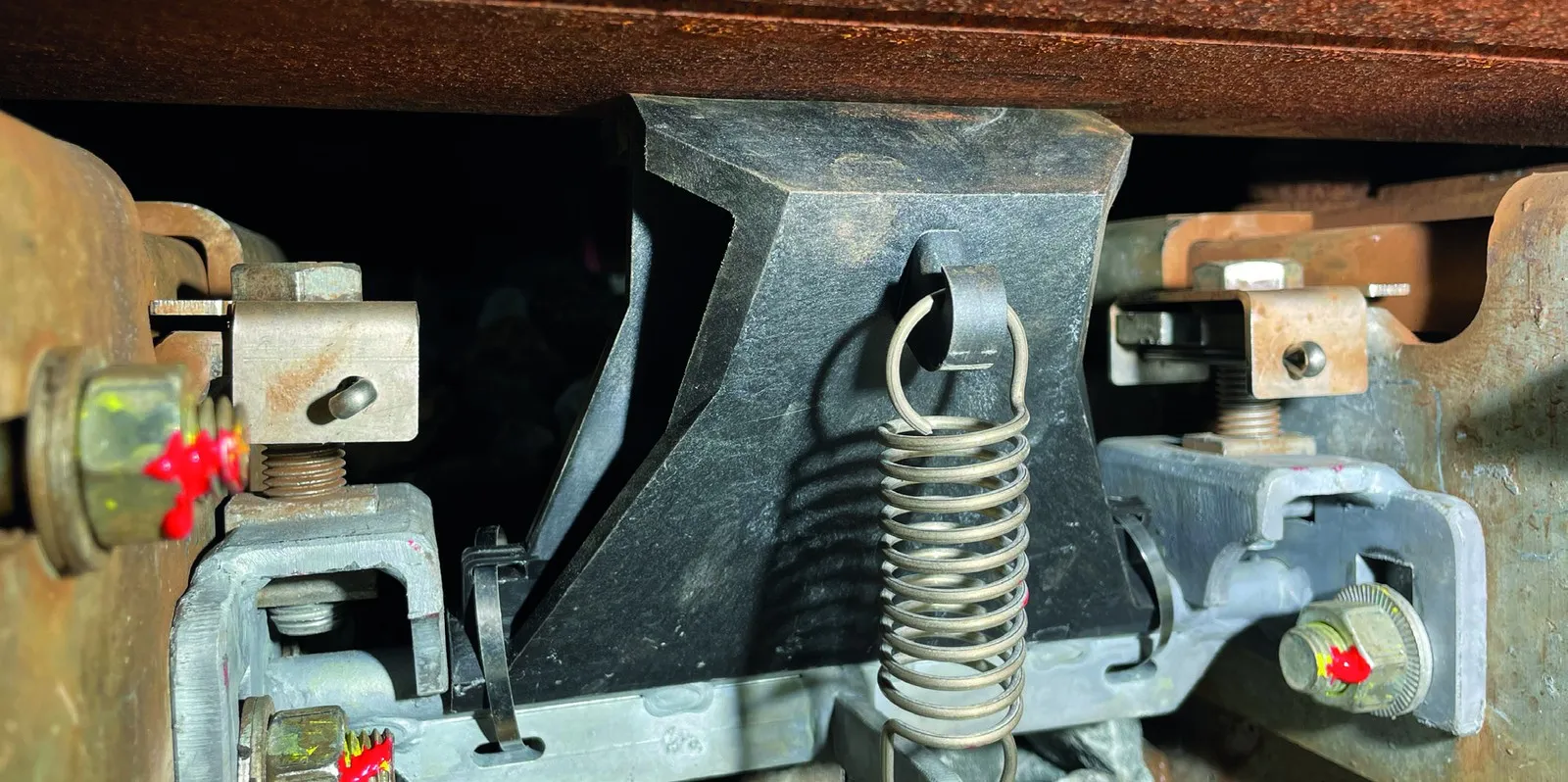
As the point machine begins the stroke, the rotating polyamide block tips and follows the switch rail's horizontal motion. A lip on one side and a spring on the other keep the block synchronous with the rail.
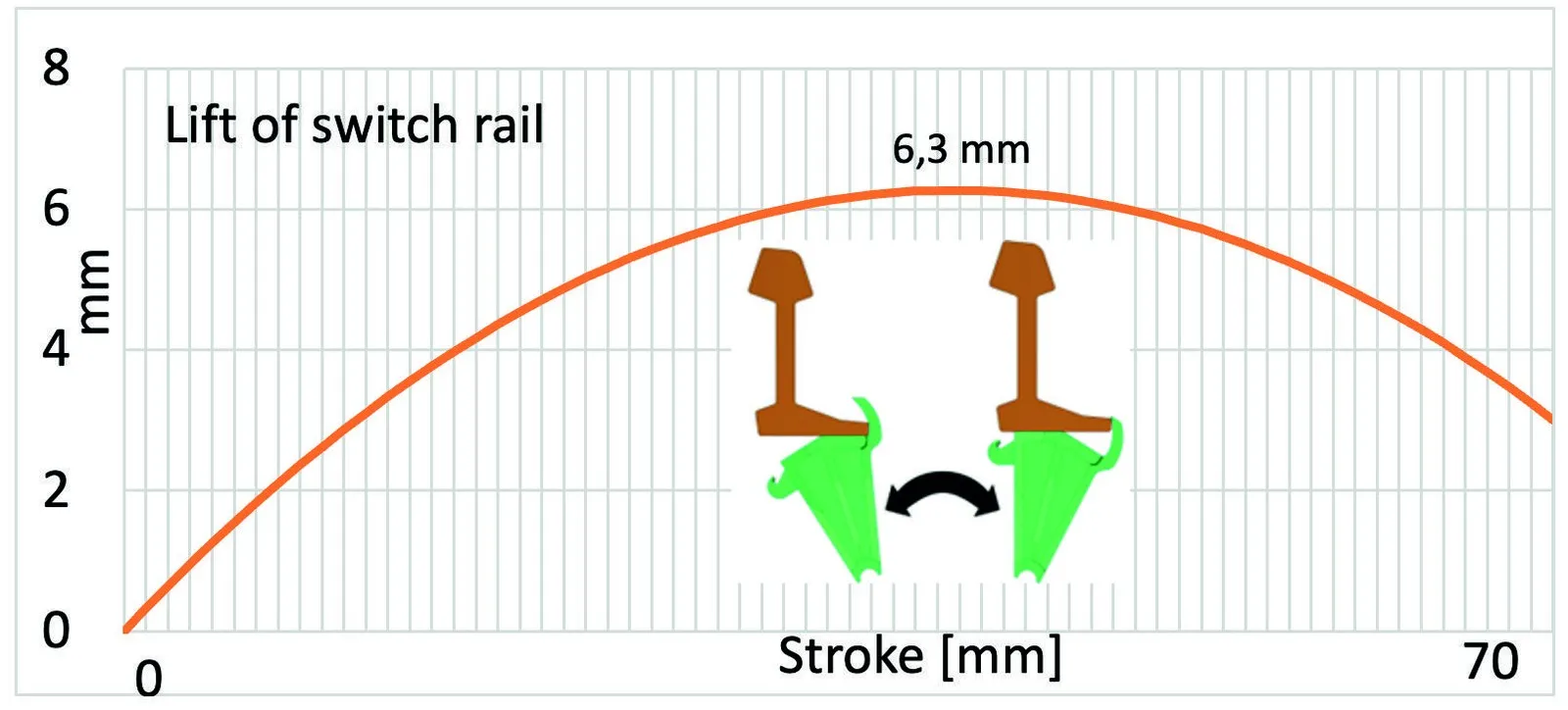
The switch rail lifts more than 6 mm.
The block lifts the rail clear of the sliding chairs at mid-stroke. Friction disappears and lubrication becomes unnecessary; often one device per switch rail is sufficient.
A stable end position locks in.
Potential energy from the lifted rail brings it firmly into the closed or open position. Gauge holds; flange-back contact is prevented.
The bistable mechanism
The throw in cross-section
During the throw the rotating pendulum block lifts the switch rail clear of the sliding chairs: up to 6,3 mm at its highest point. In the open position the rail stays 3 mm above the sliding chairs. Work the throw yourself with the slider, or drag the switch rail.
The pendulum block is shaped like an asymmetric kite: the bearing face for the open position lies 123 mm from the shaft centre, the face for the closed position 120 mm. The open switch rail therefore rests 3 mm above the sliding chairs: stable, with no sideways wobble, and it does not bounce back after being struck.
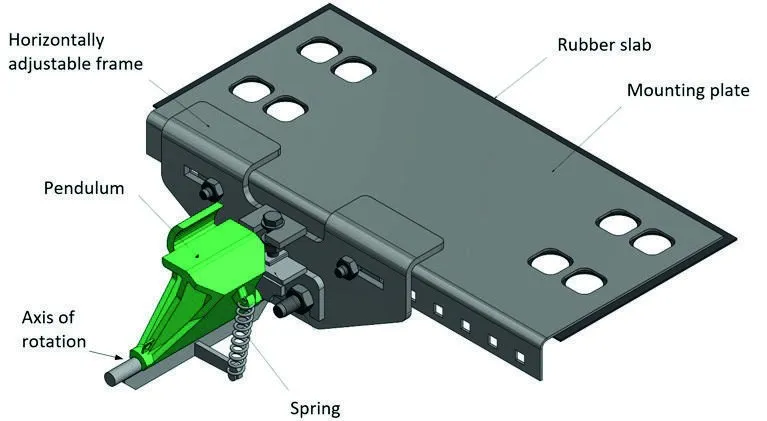
Rests on the sliding chairs in the closed position and is carried by the pendulum block during the throw. Suitable for a high or low switch rail profile.
The fixed rail the switch rail closes against. DeltaSwitch helps the switch rail close properly against the stock rail, even when it is slightly deformed.
Plastic block shaped like an asymmetric kite, pivoting about its lowest point. Its top face lifts the rail as the rail moves sideways; two flat bearing faces give two stable end positions. The raised lip makes the block travel with the rail.
Pulls the lip lightly against the side of the switch rail foot, so the block also follows the rail on its way back to the closed position, even on a slightly hogged switch rail.
The pre-assembled frame slides in between two bearers, under the sliding chairs, and carries the steel shaft. The shaft is horizontal and height-adjustable; the block turns on it without lubrication.
DeltaSwitch is fitted between two bearers; this section is taken at the pendulum block, between the sliding chairs. The baseplates carrying the stock rail fastenings sit on the bearer.
Benefits
Zero greasing, forever.
The polyamide-on-steel mechanism needs no lubricant at any point in its service life. Greasing rounds disappear from the maintenance regime entirely.
Fewer possessions, less wear.
In most cases one device per switch rail replaces multi-roller systems. Friction at mid-stroke disappears, point machines last longer and the device itself serves more than 25 years.
A reliable, repeatable throw.
Two stable end positions hold the gauge and prevent flange-back contact, independent of roller adjustment or slight rail deformation.
Nothing leaches into the ballast.
No lubricant means no contamination of ballast and soil, and a cleaner, quieter switch for the people who live and work along the line.
Certification
 Netherlands ProRail SPC00341
  Independent validation Dekra Rail Bench & on-track tested
 Technical specifications
DeltaSwitch
| Parameter | Value |
|---|---|
| Switch rail lift (mid-stroke) | 6,3 mm |
| Active stroke range | 0 – 70 mm |
| Devices per switch rail | Typically 1 |
| Bearing material | Polyamide · steel shaft |
| Lubrication interval | None |
| Operating temperature | −30 / +60 °C |
| Parameter | Value |
|---|---|
| Compatible switch types | All types |
| Switch rail profile | High or low |
| Bearer spacing (centre to centre) | 580 – 620 mm |
| Installation time per switch | ~ 1 h |
| Service life (typical) | > 25 years |
| Documentation languages | EN · DE · NL |
Comparison
DeltaSwitch vs conventional roller systems
For decades, greasing has been replaced by rollers that partially lift the switch rail in the open position. DeltaSwitch takes a different approach.
| Parameter | DeltaSwitch | Roller systems |
|---|---|---|
| Devices per switch rail | Typically 1 | 2 – 3 |
| Lift of the switch rail | 6,3 mm at mid-stroke, over nearly the full length | Partial, in open position only |
| End positions | Two stable end positions, held by the rail's own weight | Dependent on roller adjustment and bearing condition |
| Behaviour of the open switch rail | Stable, does not bounce back after being struck | Can be hit and bounce back repeatedly |
| Maintenance | Visual check; annual bolt-torque check | Adjustment and bearing condition must be maintained |
Roller-system characteristics as described in the DeltaSwitch product documentation; figures for specific third-party systems available on request.
In the field
Documentation & links
Manuals, brochures and where to order.
Frequently asked questions
Which switch types can be fitted with DeltaSwitch?
Standard switch panels such as 1:9, 1:12 and 1:15 with bearers of concrete, wood or plastic and a centre-to-centre bearer distance of 580–620 mm. The optimum position of the device depends on switch-rail length and stiffness; placement tables for common types are in the installation manual.
How long does installation take?
About one hour per switch with standard track tools. The pre-assembled frame slides under the sliding chairs of two bearers; the pendulum is adjusted under the closed switch rail and secured with locking plates and split pins. No alterations to the point machine are needed.
What maintenance remains?
A visual inspection and adjustment check one week after installation, then a bolt-torque check at the regular inspection interval (at least yearly) and after tamping. The polyamide-on-steel bearing itself needs no lubrication at any point.
Does it work with stiffened switch rails?
Yes. With a rectangular-tube stiffener the standard pendulum block fits. With an L-profile stiffener the block's lip is trimmed to a marked minimum height, or ordered pre-shortened.
Request more information about DeltaSwitch.
Datasheets, installation manuals and reference projects. An engineer replies within one working day.
Or call +31 (0)162-70 05 20
Thank you, your request has been sent.
An engineer will get back to you within one working day.