
Where service life is decided
A train wheel transfers the full vehicle weight to the rail through a contact patch of just a few square centimetres. The forces of traction, braking and curving pass through that same small patch. The stresses in and just below the tread are therefore high, and they return with every revolution. The axle carries a loading of its own: with each revolution it flexes a fraction and springs back, time after time, for its whole working life.
The damage that follows takes familiar forms. At the surface, the tread wears. Just below the surface, the material fatigues, which shows up as pitting (small pits forming in the tread) and spalling (fragments of tread material breaking out). How long a wheel or axle lasts is therefore largely decided before the part has ever run a metre: in the steel, the forging process and the heat treatment.
Forging from vacuum-degassed steel
It starts with the steel grade. For wheels, 42CrMo5 is a proven choice: a chromium-molybdenum steel that hardens well yet can be kept tough. At least as important is what happens to the melt before anything is forged at all. In vacuum degassing, the liquid steel is placed under vacuum so that dissolved gases, hydrogen among them, can escape. Hydrogen in steel can cause internal cracking; degassed steel is cleaner, and so a more reliable starting point for a part loaded in fatigue.
The forging itself does the next part of the work. The heated steel is shaped under high pressure, which compacts the material and leaves a continuous, homogeneous structure. That is no small detail: fatigue cracks usually start at a flaw in the material, an inclusion or a void. For a part whose stresses repeat every revolution, every flaw that is not there counts.
Hard tread, tough core
After forging comes the heat treatment, and that sets the character of the wheel. The aim is twofold: a uniform hardness across the tread, and a core that stays tough. The hard tread resists wear and the rolling contact fatigue that leads to pitting and spalling. The tough core lets the wheel absorb shocks and peak loads without cracking. Achieving both at once is what the heat treatment is all about: hard enough at the surface to last, tough enough inside to stay safe. The uniformity of that tread hardness is itself a mark of quality: a wheel that is equally hard everywhere behaves the same around its whole circumference and wears predictably.
That predictability carries through into maintenance. A tread with wear or early damage is turned back to a sound profile in the workshop, and a wheel can go through that several times in its life, until the minimum diameter is reached. The more uniform the material, the easier it is to predict how much has to come off each time and how much wheel is left. Quality put in at the forging and hardening stage pays itself back over the whole service life.
The standards and what they cover
For the main line, all of this is laid down in standards, each with its own scope:
- Train wheels: EN 13262. Forged wheels are manufactured to EN 13262 and available in diameters from 360 to 1290 mm, in a range of materials.
- Wheel tyres: UIC 810-1. Tyres are supplied to UIC 810-1 and are used for re-tyring and wheelset refurbishment: the tread is renewed without replacing the complete wheel.
- Axles: EN 13261. Axles are supplied to EN 13261, in various sizes and materials.
- Complete wheelsets. Wheels and axles are delivered as assemblies: matched, mounted and ready to fit.
For the buyer, these standards mean predictability above all: a wheel or axle built to the standard is interchangeable and has been tested under a defined regime. The choice that remains is one of maintenance strategy: separate wheels, tyres and axles for refurbishment in-house, or complete wheelsets fitted as a whole. Both routes are common practice; the trade-off differs by operator and by fleet.
The drivetrain: cardan shafts
Powered vehicles add one more link: the cardan shaft, which transmits torque from the motor to the wheels. Here the quality lies in the universal joints and their bearings. Roller-bearing-mounted universal joint shafts are built to a high quality standard, with a broad range so the shaft can be tailored to the application. Here too, service life is decided in the factory, in material and bearings, long before the shaft makes its first revolution.
The same recipe beyond the main line: crane wheels
Wheels on rails are found outside the railway too. Gantry and harbour cranes run on crane rails and concentrate comparable loads on a comparably small contact patch. And the answer is the same: crane wheels are forged in 42CrMo5 steel and heat-treated for a hard running surface. The same forging and heat-treatment logic as for the train wheel, applied to the crane runway.
Where we come in
Kampa supplies these parts through its established partner programme. The forged wheels, tyres, axles and complete wheelsets come from Lucchini RS. The cardan shafts come from Gelenkwellenwerk Stadtilm GmbH (GEWES), certified to ISO 9001, ISO 14001 and ISO 50001. Kampa also supplies and supports forged crane wheels in the Benelux. All of it comes with engineering support: our engineers help think through dimensions, material and application. If what you are looking for is not among them, we help you find it through our network of manufacturers.
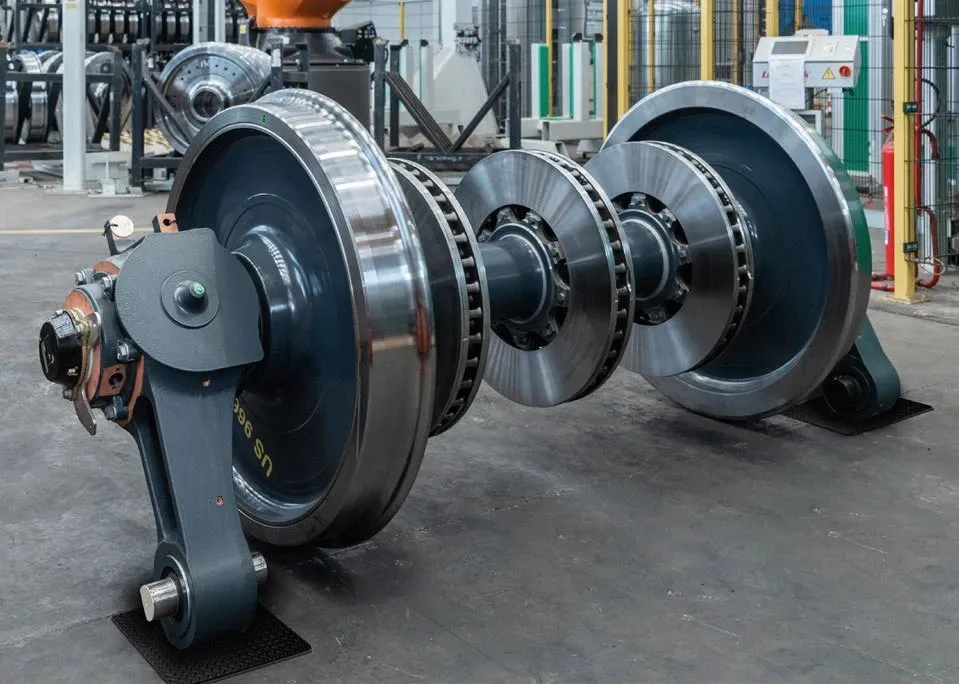
A complete Lucchini wheelset: two wheels mounted on an axle with bearings.