
Why switches are greased
Smooth movement of the switch rails is essential for safe, reliable switches and crossings. During the stroke the switch rail slides over the slide chairs, and without countermeasures the friction is considerable: the point machine has to work harder and the stroke becomes less reliable. A switch that fails to reach detection after the stroke results in a train service disruption. Greasing is the classic answer. It keeps the movement smooth, as long as it is done regularly.
That proviso is the heart of this story. Anyone wanting to keep the friction in a switch under control chooses, in practice, between three routes: keep greasing, put the switch rail on rollers, or lift the rail during the stroke. Below we set them side by side, starting with where that friction actually comes from.
How the friction arises during the stroke
The switch rail is a long, heavy length of rail resting with its full weight on a row of slide chairs. On every stroke the rail moves tens of millimetres sideways, and without lubrication that is dry steel sliding over steel. The point machine has to overcome that resistance every time. Anything that makes the movement heavier feeds straight into the throwing force and into the reliability of the end position; minimising friction extends the service life of the point machines and contributes to higher availability of the track.
The consequences of a stroke that does not complete properly are plain to see on the Dutch network. Problems with insufficient flangeway clearance or gauge narrowing occur mainly on switches with relatively long switch rails, and slightly deformed switch rails often fail to close properly against the stock rail. On switches with a single point machine there is the added risk that the free wheel passage dimension is not achieved, so that the flangeway clearance shrinks and the back of the open switch rail can be struck by the wheel flanges of a passing train. In the Netherlands, hundreds of switches are hit that way every year. The fluctuating loads this places on the switch components lead to fatigue, wear or worse.
What the greasing regime costs
Greased slide chairs are a recurring cost. Greasing rounds demand labour and access to the track time and again, and that means possessions. And the grease does not stay where it belongs: part of it washes into the ballast bed and the soil. Greasing is thus an environmental cost as well as a maintenance cost.
Nor does the regime solve anything for good. Stop greasing without an alternative and the friction, and with it the wear, returns immediately. The rounds keep the problem manageable for as long as they continue, and that is precisely why they reappear on the agenda every planning period.
Rollers: partially lifting the switch rail
For decades, greasing of slide chairs has been replaced by roller systems that partially lift the switch rail as it moves to the open position. That helps, and it has been widely applied. But it comes with conditions. Each switch rail needs at least two or three rollers, and proper functioning requires correct adjustment and good bearing condition on every roller; when a roller seizes, the effect is the opposite of what was intended. The lift is also partial: not the whole rail is carried in the open position. And there is more: a rail resting on rollers in the open position can be struck by passing wheels and then bounce back repeatedly, which can amplify the wandering.
For infrastructure managers who keep their rollers well maintained, this is a workable route. The maintenance demand simply shifts: from greasing rounds to adjustment and bearing checks.
Lifting the rail: the bistable pendulum block
The third route tackles the friction itself. A tilting polymer block, placed between two bearers roughly midway between the toe and the heel of the switch, rotates about a steel shaft. That shaft is part of a frame mounted under the slide chairs of two bearers. The block has the shape of an asymmetric kite rotating about its lowest point, with two flat bearing faces on which the switch rail rests.
As soon as the point machine begins the stroke, the block tips and follows the switch rail’s horizontal motion. An upstanding lip on the inner side and a spring on the outer side make the block follow the rail synchronously, even if the block momentarily loses contact with the underside of the rail, as on a hogged switch rail. At mid-stroke the rail is lifted as much as 6 mm clear of the slide chairs. From that highest point, gravity does the rest: the potential energy of the lifted rail completes the throw and brings the rail firmly into the closed or open end position.
Those two flat bearing faces are the core of the bistable principle. In both extreme positions the rail lies stable and will not wander horizontally. One bearing face sits 3 mm further from the pivot than the other, so the open switch rail rests 3 mm above the slide chairs. The gauge thus stays secured, independent of roller adjustment or slight deformation of the rail, and striking of the switch rail is prevented. The bearing is formed by polyamide on a steel shaft; thanks to the block’s large active radius the friction is next to nil, and the mechanism needs no lubrication at any point in its service life. Because the lift is more than 6 mm, one device per switch rail is usually sufficient, so two per complete switch, depending on the switch type.
This route too demands care. The optimum position of the device depends on the length and stiffness of the switch rail and differs per switch type, and on installation the pendulum has to be adjusted under the closed switch rail and secured.
Where the maintenance ends up
All three routes keep a switch operable; they differ chiefly in where the maintenance ends up. With greasing, the rounds keep returning for as long as the switch is in the track. With rollers, the greasing rounds lapse, but the adjustment and the bearing-condition checks of two or three rollers per switch rail take their place. With the lifting principle, what remains is visual inspection, plus a periodic bolt-torque check and a check after tamping. The difference also lies in what happens when the maintenance is skipped for once: with greasing and rollers the friction or the play creeps back in; with the lifting principle the mechanism itself keeps working as before.
Where we come in
For that last route we developed DeltaSwitch. The system suits all types of switches and high or low switch rail profiles. It is supplied pre-assembled and can be installed in about an hour per switch with standard track tools; no alterations to the point machine are needed. The device serves more than 25 years, is covered by a ProRail product specification in the Netherlands and validated with bench and on-track tests by Dekra Rail. Proven in service in the Netherlands, Belgium and Canada.
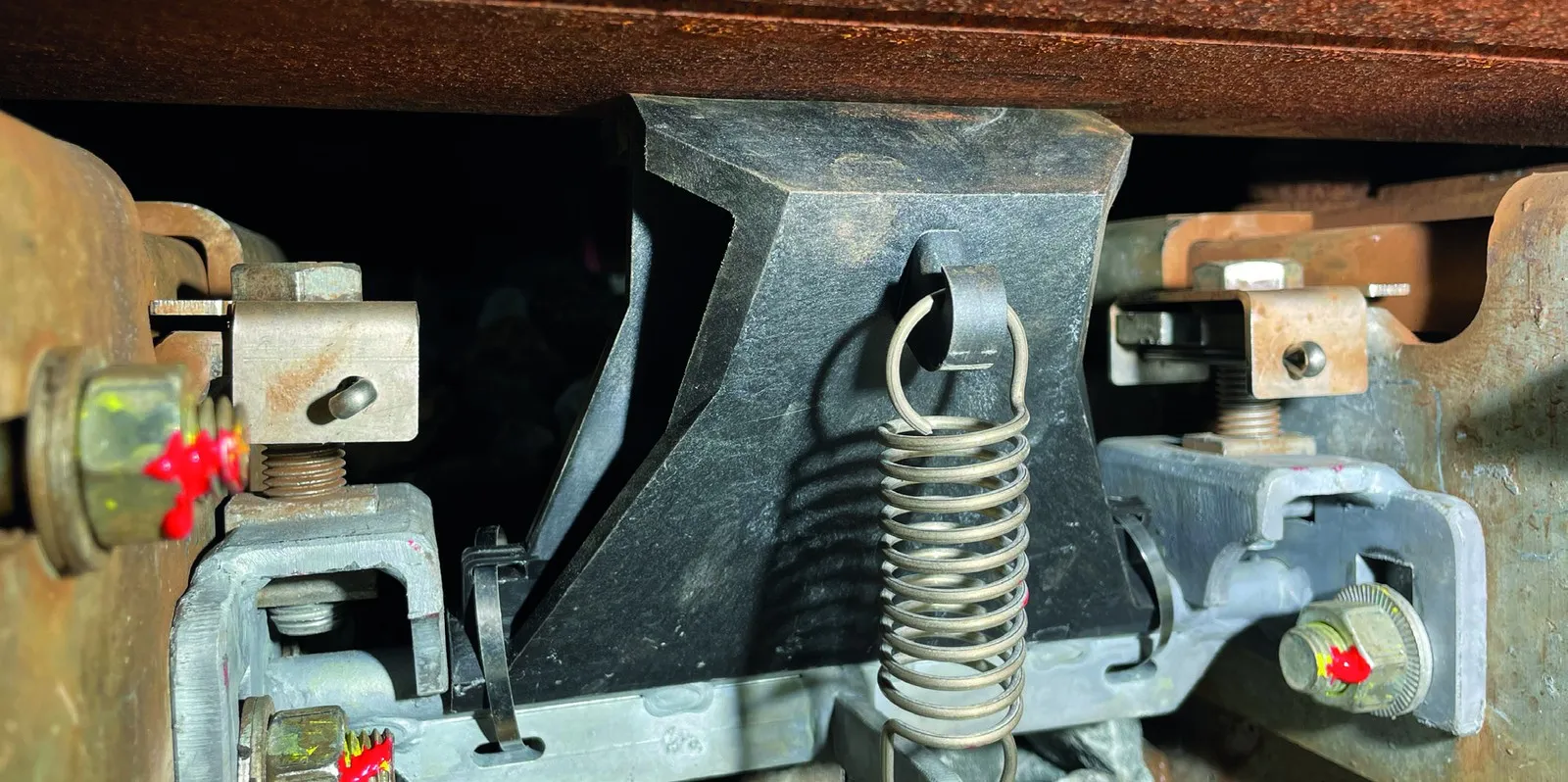
The fibre-reinforced pendulum block with tension spring, under the switch rail.