
Where cables cross the track
Cables run alongside every railway line, and in many places they have to get from one side of the track to the other. Current practice is much the same everywhere: the track-crossing cables sit in a cable duct that crosses the ballast bed between two sleepers. In station areas, where tracks and cable routes sit close together, the picture is easy to recognise: ducts at several points between the sleepers.
As long as the track is left alone, nobody notices. That changes as soon as the track geometry needs maintenance, and in ballasted track that moment comes round regularly.
What the tamping machine needs
To restore the track geometry, a tamping machine compacts the ballast bed beneath the sleepers. To do so, the machine has to drive its tamping tines into the ballast bed between the sleepers and press the ballast in under the sleeper. For the tamping machine, the space between two sleepers is a precondition: it is precisely where the machine does its work.
A cable duct for track-crossing cables sits, by definition, in that same space. That makes the conflict a fact, and it brings two problems.
The first: the track at the cable duct cannot be tamped properly. The machine cannot do there what it came for, so the geometry at that spot is not properly restored.
The second: if tamping does go ahead, the duct itself runs a real risk of being damaged. And that duct holds precisely the cables, and sometimes gas pipes, that cross the track.
Nor is the conflict a one-off. A cable crossing stays in place for years, and tamping returns periodically. At every tamping cycle the same choice presents itself again: skip the spot or risk the duct.
The options side by side
Anyone who has to fit in a cable crossing, or comes across one during renewal, has broadly two routes.
- The cable duct between the sleepers. The familiar approach: the duct crosses the ballast bed between two sleepers and the cables sit inside it. No intervention in the track itself is needed, which makes this the simplest route at installation. The bill comes later: at every tamping cycle the duct sits in the machine’s working area once again, with the drawbacks mentioned above.
- The crossing through a hollow sleeper. A hollow steel sleeper takes the place of an ordinary sleeper, and the track-crossing cables are laid in the bearer itself. The crossing thereby moves from the space between the sleepers into the sleeper itself: the ballast bed stays clear and the track can be tamped normally. Where several tracks sit side by side, the cables run through the hollow bearers from one track to the next. With this route the trade-off sits at the front end: the sleeper has to be installed in the track, which combines well with track renewal. Existing ducts are then removed, and hollow sleepers take the place of the marked sleepers. These are just as heavy, just as stiff and just as strong as concrete sleepers. Beyond the crossing the cables simply run on through the cable duct alongside the track, and a ‘cable present’ (Kabel aanwezig) plate on the pass-through marks for later work that there is cable in the sleeper.
Both routes are defensible; the difference lies in where the burden falls. The duct between the sleepers is simple at installation and pushes the conflict with tamping on to every subsequent maintenance round. The hollow sleeper calls for an intervention at installation and then takes the conflict out of the ballast bed. The more often a section of line is tamped, the heavier that second argument weighs.
Where we come in
Kampa supplies a product of its own for this situation: the Kampa Sleeper, a hollow steel sleeper that routes track-crossing cables through the bearer. The ballast bed stays clear, the track can be tamped normally and the cable duct in the track is no longer needed. The product page carries brochures in Dutch and English; our references page shows the bearer in the track, photographed during track renewal.
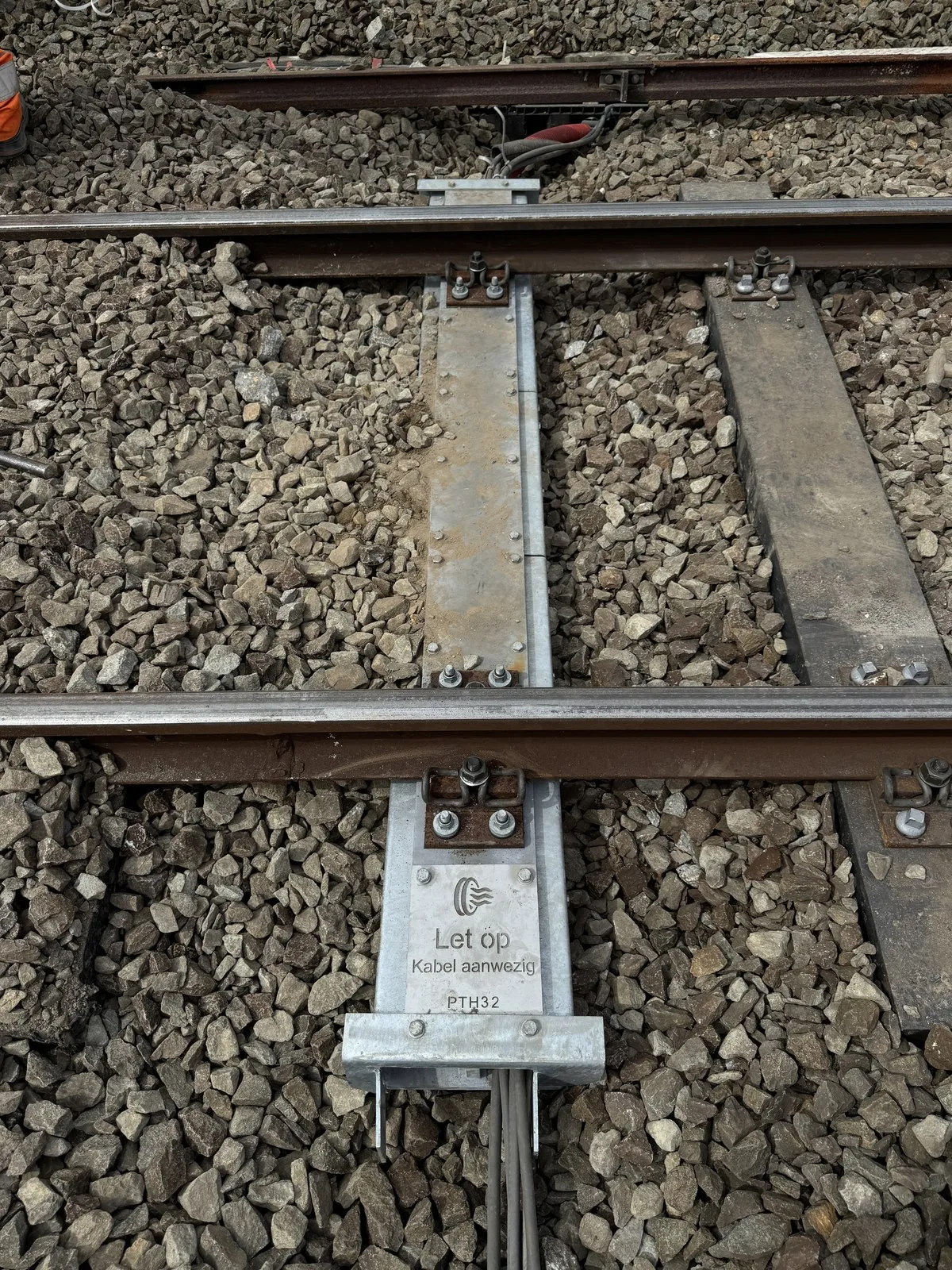
Top view: the bearer crosses the track with the cables inside, the ballast bed clear around it.