A barrier at ground level
Rail infrastructure is a barrier for amphibians. Toads, frogs and newts are ground-bound, slow-moving and site-faithful: they move at ground level, take a long time to cross and keep to the same routes and the same waters. A railway line through their habitat cuts off the route to the breeding waters and to new habitat. It is precisely that combination of traits that turns the line into a barrier for this group: an animal that cannot get across the track, is slow to cross it and will not look for another way round ends up cut off from its water. Site-faithful also means the animals do not reroute: if the crossing goes, the connection between habitat and breeding water goes with it.
De-fragmentation through dedicated fauna passages reconnects these severed habitats and restores the route the track had cut off. The only question is where such a passage fits, because the railway sets constraints of its own: on the structure, on the water level and on maintenance.
Two limits on the standard tunnel
The usual solution is an amphibian tunnel crossing beneath the line. Such a tunnel is bounded on two sides. At the top it must sit 1.80 m below top of rail for structural reasons. At the bottom it must stay at least 0.10 m above the highest water level in order to function. The complete passage has to fit between those two limits.
In some places it can. But many of the sites where an amphibian tunnel is needed lie in amphibian habitat with a high expected water level; amphibians live where the water is. Where the groundwater sits high, the two limits close in on each other, and between 1.80 m below the rail and 0.10 m above the water too little room is left to build a tunnel. Within those constraints the standard passage simply cannot be realised there. The result is an awkward situation: exactly where the need for a passage coincides with wet habitat, the usual solution drops out.
The alternatives side by side
For those wet sites, alternatives have been explored in the past, among others within the MJPO, the Dutch multi-year de-fragmentation programme, but none of those earlier alternatives closes the gap. The possible approaches, one by one:
- Standard amphibian tunnel. The reference solution wherever there is room for it. Drops out at sites where the water level is too high for the required depth.
- Amphibian gutters between the sleepers. Put the passage in the track itself, with no deep alignment needed. They are too small for the animals, however, and obstruct the machine maintenance of track and ballast.
- Standard concrete cable ducts. Used as a passage, the same objections apply: too small for the animals, and between the sleepers they sit in the way of the maintenance machinery.
- Ballastless structures. Too expensive to build or hard to maintain. They also create transitions in the track.
- A passage integrated in the sleeper. The passage sits between the sleepers, in the ballast bed. That way it also works at sites where the room between top of rail and water level rules out a standard tunnel, and the profile for machine maintenance stays clear.
Three requirements keep returning in this comparison: a passage must be roomy enough for the animals, must stay above the highest water level and must leave the maintenance of the track untouched. Each of the earlier alternatives founders on at least one of those points; each carries ecological, technical or economic drawbacks.
Maintenance has a say
That third requirement deserves a paragraph of its own, because in the design it often makes the difference. Track and ballast are maintained by machine, and any provision between the sleepers sits squarely in the working area of that machinery. Gutters and cable ducts in that profile obstruct tamping and ballast work; ballastless structures avoid that conflict, but at high construction or management costs.
A passage that sits in the ballast bed but stays clear of the machine maintenance lets tamping and ballast work continue as normal. For the infrastructure manager that means an ecological measure that leaves the regular maintenance regime untouched, and so never forces a choice between nature and track quality in the longer term either, and which can be realised at low cost.
Where we come in
For the sites where the standard tunnel does not fit, Kampa developed the Dwarsligger Faunapassage: a sleeper-integrated amphibian crossing that sits between the sleepers in the ballast bed. The passage functions at sites with a high groundwater level, stays clear of the machine maintenance of track and ballast and de-fragments the landscape. On the product page you will find an animation of how it works and the installation and maintenance manual.
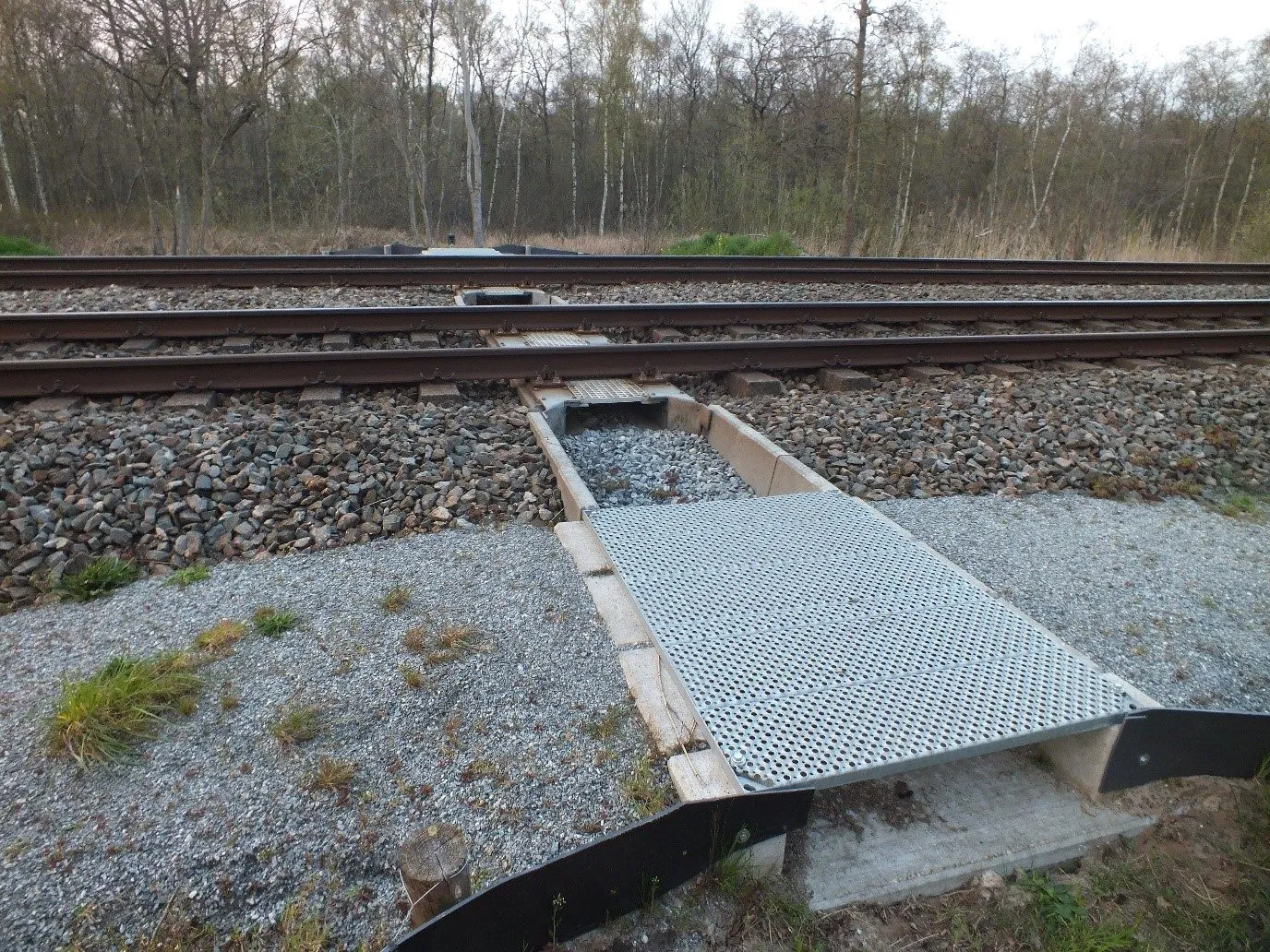
The entrance to the passage, with grating deck and retaining walls.