
Loose plates on the UNI crossing
The road surface of a UNI crossing (Universal Crossings Model ‘98) consists of prefabricated concrete crossing plates. In a standard UNI crossing those plates sit loose next to one another, without any connection between them: each plate lies in the track on its own, and nothing holds the plates together as a whole. Several plates are admittedly locked in by supports on the sleepers, but these shift when the crossing expands or is loaded.
The plates can then drift apart and joints open up. Those joints are a hazard for the road traffic crossing the track, cyclists in particular. The problem therefore sits in the construction itself: as long as the plates are not connected to one another, any joint can start to open again.
The locking construction and sleeper position
To hold the plates in place, the UNI crossing relies on a conventional locking construction that is fixed to the sleepers next to the crossing. Even when these have been placed precisely, shifting of the sleepers can undo the locking’s effect.
Then there is the maintenance. Work on a UNI crossing can only be carried out during a track possession, which makes the maintenance relatively costly. It also limits when and how often the joints can be addressed: a joint that has opened can only be closed at the next track possession.
Maintain or clamp
Anyone wanting to keep the joints of a UNI crossing closed has broadly two routes.
- Maintaining within the existing construction. The plates remain loose and the conventional locking construction keeps doing the work. When the plates drift apart, the joints are dealt with during a track possession. This route requires no modification of the crossing. The trade-off is that the cause, the missing connection between the plates, remains, and every intervention again requires a track possession.
- Clamping the plates together permanently. A retensioning system replaces the conventional locking construction, not only for the inner plates but for the outer plates too. At its core is a tie-rod that runs underneath the plates and is brought to tension with a nut and a disc-spring pack. The spring pack holds that tension permanently, so the plates stay clamped together and the joints stay closed, even when the plates expand or contract with temperature. Because the clamping acts on the plates themselves, it works independently of sleeper position.
Which route fits depends on the crossing itself: how often the joints reopen there, and what a track possession at that location costs in money and availability.
Where we come in
For the second route, Kampa supplies NIOP, the Naspan Inrichting OverwegPlaten: our own retensioning system for UNI crossings. The outer-plate tensioner sits just outside the sleeper ends; the tensioner for the middle crossing plates sits at the track centreline and includes a run-up plate to protect loose-hanging couplings. NIOP can be applied to all heavy-rail UNI crossings in the Netherlands with NS90, 14-002 and wooden sleepers. If you would like to know whether that also holds for a specific crossing in your area, we are happy to find out with you.
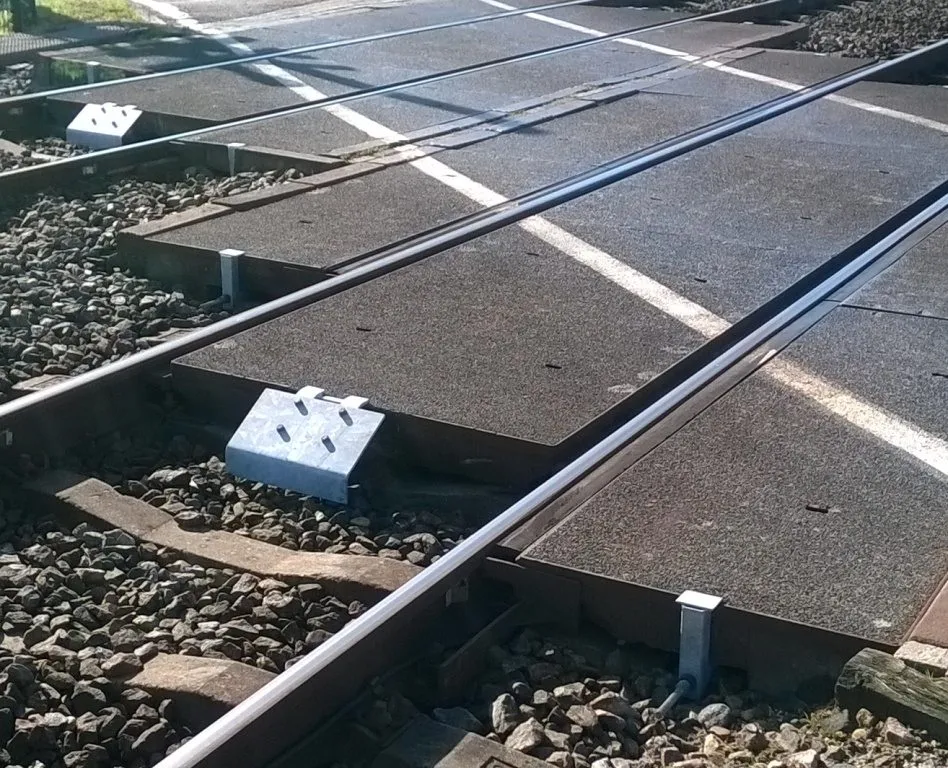
NIOP in service at a UNI level crossing.