
More and more rollators on board
More and more elderly passengers and people with reduced mobility travel with a rollator, on the bus, the tram and the train. For the passenger it is a familiar device: walking support and seat in one, at home and on the move. For the operator it is an object on wheels that needs a safe place on board, every journey again.
That friction shows at two moments. When boarding, the passenger has to find a seat, move across to it and park and secure the rollator separately. That costs time, and that time affects the timetable and the driver’s work. And during the journey the rollator stands somewhere in the vehicle, often held only by its own brakes.
What happens during the journey
A vehicle accelerates, brakes and corners, and anything standing loose moves with it. A rollator held only by its own brakes can shift or tip over.
The most vulnerable moment is the move itself. Anyone stepping from the rollator to a seat lets go of their own support in a vehicle that may pull away at any moment. For someone who needs the rollator precisely to stand stably, that is a fall risk.
There is also a capacity side: a passenger who moves to a bench occupies a regular seat, while the rollator takes up space alongside it as well.
Two approaches side by side
- Moving to a seat. The passenger parks the rollator and sits down on a regular seat. This approach needs no modification to the vehicle and works everywhere, but it contains exactly the pain points above: the move itself, the loose rollator and the occupied seat.
- Staying seated on their own device. The rollator is placed in a fixed unit in the vehicle and locked, and the passenger stays on the rollator’s own seat, with a hand on a fixed support. The move disappears, the rollator is secured and a regular seat stays free. In return, the vehicle needs a unit, mounted at an accessible spot, and that spot has to be worked into the layout.
How such a wall unit works
A wall unit built on this principle goes through four steps:
- The passenger rolls the rollator into the unit and applies both of its brakes.
- The rollator is locked to the wall unit and stays in place.
- The passenger stays seated on the rollator’s own seat, with a hand on a fixed support.
- At the stop the rollator releases and the passenger steps off with it. The unit is then ready for the next user.
The locking is fully mechanical and extremely simple. That means a long service life and hardly any maintenance, with little disruption to the timetable.
Where we come in
Rollator-Rest works on this principle. The unit is developed by Moveside AG, a Swiss accessibility specialist, and the design was proven in a practical test with Zürich’s public transport operator, VBZ. Kampa supplies and supports Rollator-Rest in the Benelux; our engineers advise on how it fits into your vehicles.
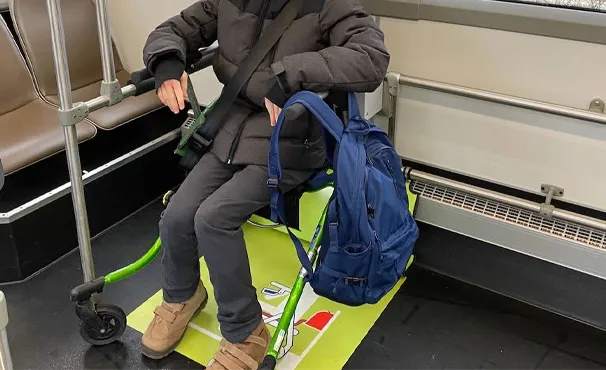
The passenger stays seated on their own rollator, held by the floor guide.