
Where rail noise comes from
Most rail noise is generated where wheel and rail meet: roughness on the wheel tread and the railhead sets both vibrating, and that vibration is radiated as noise. In tight curves, curve squeal comes on top. And on bridges, in tunnels and near sensitive buildings a third route comes into play: vibration passed on through the structure and the ground, audible as structure-borne noise.
The measures side by side
- Rail dampers. Tuned mass dampers, clamped to the rail web, reduce broadband rolling noise at the source and slow the formation of rail corrugation. Measurements across a wide range of tracks back an average reduction of 2 – 6 dB(A).
- Wheel dampers. Dampers fixed to the solid wheel cut rolling noise by up to 6 dB(A) and curve squeal by up to 18 dB(A); on tested tram lines curve squeal is eliminated entirely.
- Quieter brake blocks. Composite K and LL brake blocks keep the wheel tread smoother than cast iron, so rolling noise drops substantially. Retrofitting to quieter brake blocks is cheaper noise control than, for example, line-side barriers.
- Ballast mats. Resilient mats under the ballast bed cut structure-borne noise and vibration on bridges, in tunnels and near sensitive buildings, while protecting both the structure and the ballast bed.
- Noise barriers. Barriers act on the path between source and receiver and leave the source itself untouched. Locally they can achieve a great deal, but track and rolling stock remain just as loud; the noise is still there, merely screened off.
Source or path: when each pays off
A measure at the source works everywhere the vehicle or the track goes; a barrier works only where it stands. Which approach fits depends on the dominant source: rolling noise calls for smooth wheel treads and damping on the rail or the wheel, curve squeal for damping on the wheel, and vibration at bridges and other structures for resilience under the ballast bed. In practice it is often a combination, and it pays to measure first where the noise is coming from.
Where we come in
Kampa supplies measures for each of these routes: VICON AMSA rail dampers and VICON RASA wheel dampers from Schrey & Veit, composite brake blocks and organic brake linings from Wabtec, and ballast mats and track elastomers from Calenberg. Our engineers help you work out which combination suits your situation.
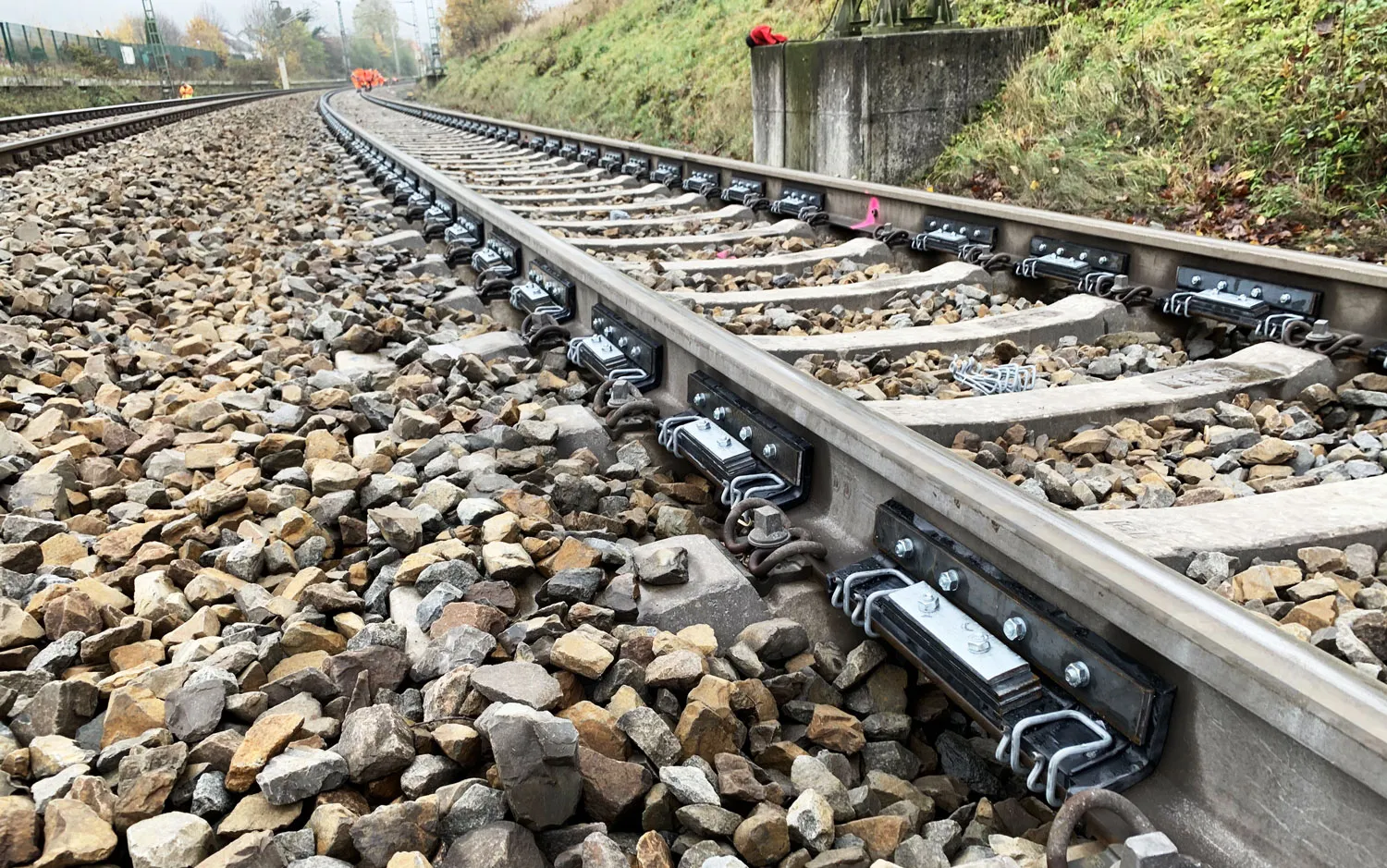
VICON AMSA rail dampers, clamped to the rail web.